Research
My research explores several areas in gravitational physics, with a current focus on gravitational-wave astronomy. Below are the main topics I work on.
-
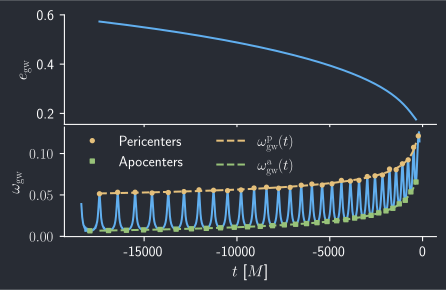
Defining eccentricity for GW astronomy
Defines a standard framework for measuring eccentricity in gravitational wave (GW) astronomy, along with methods to calculate eccentricity directly from gravitational waveforms.
Read more
In General Theory of Relativity, there is no unique way to define the eccentricity of a binary system's orbit. This can lead to ambiguity about the binary's eccentricity inferred from GW observations. In our works, we propose a standardized definition that relies solely on the gravitational waveforms, removing gauge ambiguity and model dependence. This standardized definition can be used to measure eccentricity from gravitational waveform emitted by binaries on generic bound orbits.
A Python implementation of the method is available on GitHub: gw_eccentricity.
Papers
- Defining eccentricity for gravitational wave astronomy Phys. Rev. D · 2023
- Defining eccentricity for spin-precessing binaries Class. Quant. Grav. · 2025
- Comparison between best-fit eccentricity definitions and the standardized definition of eccentricity Phys. Rev. D · 2025
Collaborators
- Vijay Varma
- Antoni Ramos Buades
- Harald Pfeiffer
- Michael Boyle
- Mark A. Scheel
- Larry Kidder
-
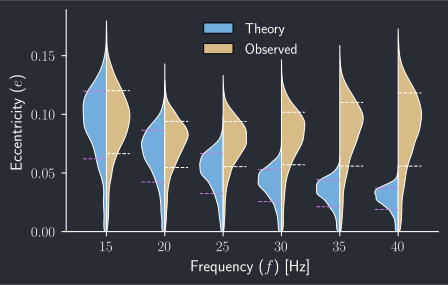
Eccentricity Evolution Consistency Test (EECT)
A test to identify truly eccentric signal and discard eccentricity mimickers.
Papers
- Eccentricity evolution consistency test to distinguish eccentric gravitational-wave signals from eccentricity mimickers Phys. Rev. D · 2025
- Testing the nature of GW200105 by probing the frequency evolution of eccentricity Astrophys. J. · 2025
Collaborators
-
Test of General Relativity using GWs
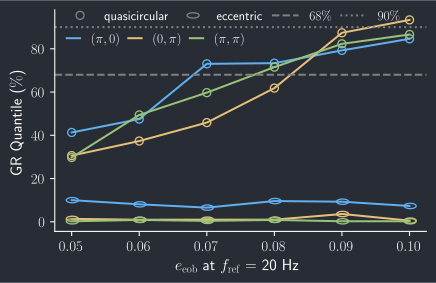
The Inspiral-Merger-Ringdown Consistency Test (IMRCT) is a key tool for testing the validity of General Relativity (GR) using gravitational waves (GWs) emitted by compact binary systems. We extend this test to GW signals from eccentric binaries.
Read more
IMRCT meets eccentricity
The IMRCT is usually performed using quasicircular template which assumes the binary's orbit to be circular. We first show that using quasicircular template for IMRCT on eccentric signals may lead to false violation of GR. We then show that when the IMRCT is performed using eccentric template such spurious violation of GR goes away. This emphasises the need for using eccentric templates when analysing GW data and performing test of GR using GW observations.
Papers
- A study of the inspiral-merger-ringdown consistency test with gravitational-wave signals from compact binaries in eccentric orbits Phys. Rev. D · 2024
Collaborators
-
Gravitational Lensing of GWs
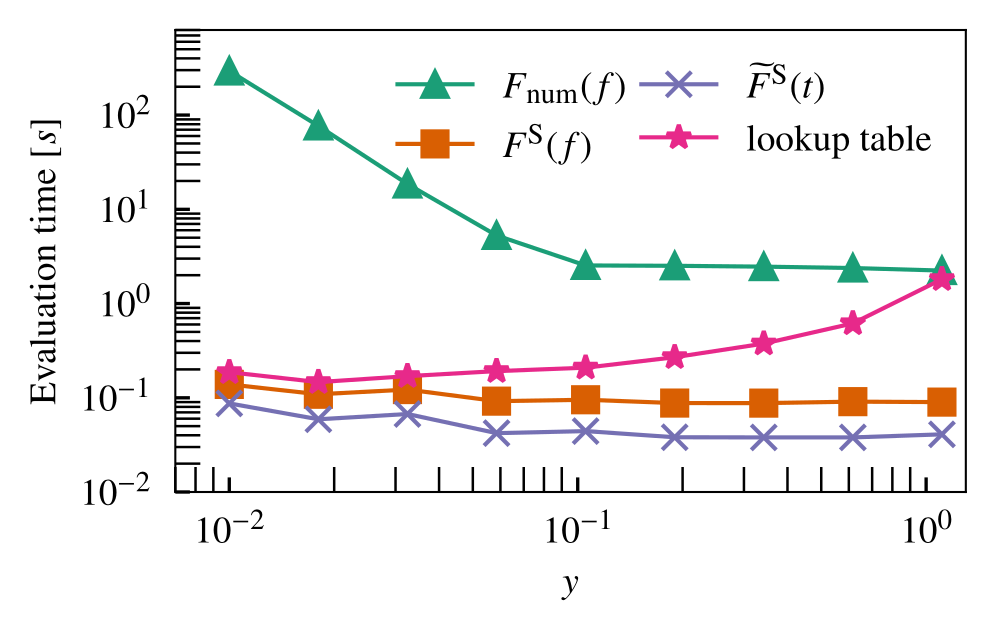
We build fast and accurate surrogate model of microlensed gravitational wave, and probe nature of the lens using gravitational wave observations.
Read more
Fast and accurate microlensing template via surrogate modeling
This study focuses on modeling the gravitational microlensing effect on gravitational waves (GWs) produced by different lens configurations.
The microlensing effect is computed via a numerically expensive integration, making the generation of templates required for gravitational wave (GW) data analysis prohibitive. We circumvent this challenge by applying surrogate modeling techniques. The surrogate model enables fast and accurate generation of microlensed GW templates, making parameter estimation from GW observations feasible.
Probing the nature of black holes using microlensing of GWs
The research highlights the potential of gravitational wave microlensing as a tool to probe the properties and nature of the lens, offering new insights into the nature of the lens black hole.
Papers
- Probing the charge of compact objects with gravitational microlensing of gravitational waves Phys. Rev. D · 2025
- Surrogate modeling of gravitational waves microlensed by spherically symmetric potentials Phys. Rev. D · 2025
Collaborators
- Uddeepta Deka
- Shasvath Kapadia
- Parameswaran Ajith
- Vijay Varma
- Scott Field
-
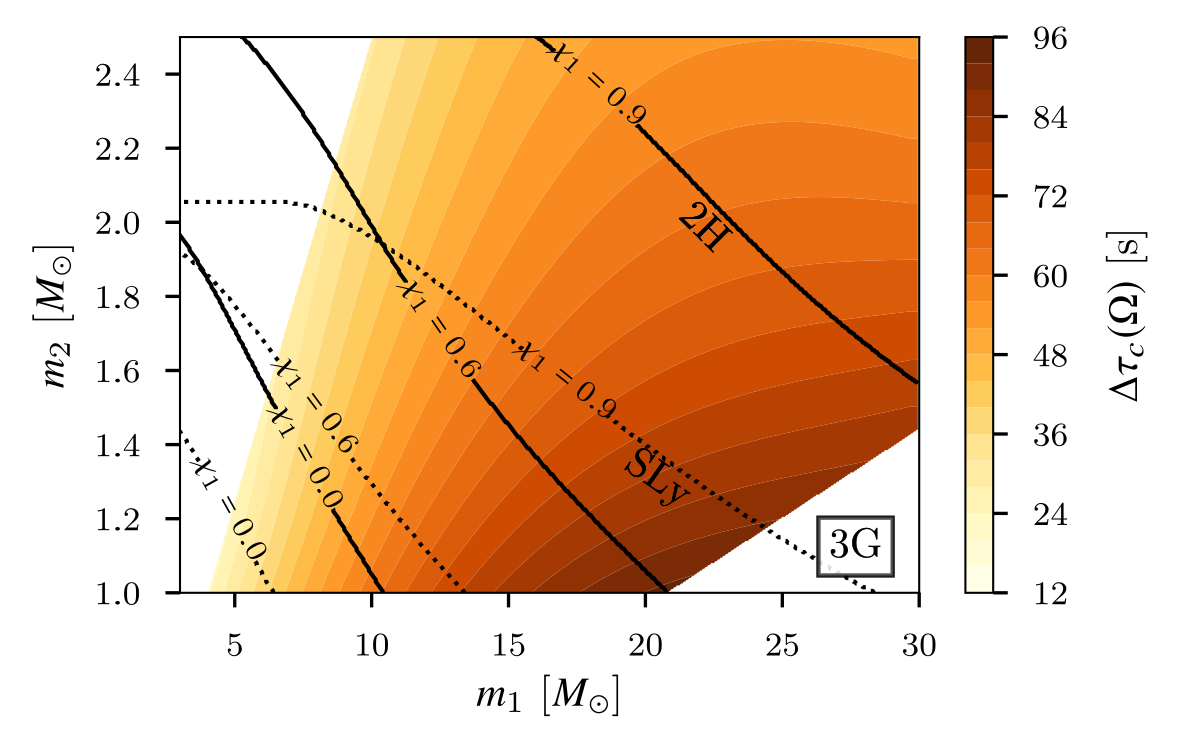
Early warning with GW higher modes
Papers
- Of Harbingers and Higher Modes: Improved gravitational-wave early-warning of compact binary mergers Astrophys. J. Lett. · 2020
- Improved early warning of compact binary mergers using higher modes of gravitational radiation: A population study Mon. Not. Roy. Astron. Soc. · 2021
- Deep Learning with Quantized Neural Networks for Gravitational-wave Forecasting of Eccentric Compact Binary Coalescence Astrophys. J. · 2021
- Improved early-warning estimates of luminosity distance and orbital inclination of compact binary mergers using higher modes of gravitational radiation Mon. Not. Roy. Astron. Soc. · 2022
Collaborators
- Shasvath Kapadia
- Mukesh Kumar Singh
- Parameswaran Ajith
-
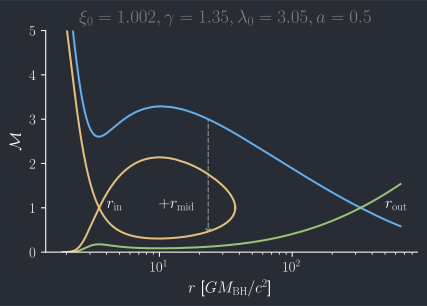
Black hole accretion and analogue gravity
Papers
- Relativistic sonic geometry for isothermal accretion in the Schwarzschild metric Class. Quant. Grav. · 2017
- Acoustic geometry obtained through the perturbation of the Bernoulli's constant New Astron. · 2018
- Relativistic sonic geometry for isothermal accretion in the Kerr metric Class. Quant. Grav. · 2018
- Linear perturbations of low angular momentum accretion flow in the Kerr metric and the corresponding emergent gravity phenomena Phys. Rev. D · 2018
- Effective sound speed in relativistic accretion discs around Schwarzschild black holes New Astron. · 2019
- Carter-Penrose diagrams for emergent spacetime in axisymmetrically accreting black hole systems Phys. Rev. D · 2022
Collaborators